The 3 Best Zigbee Sticks for Home Assistant in 2026 (Reviewed)
Best Zigbee Stick For Home Assistant The best Zigbee stick for Home Assistant in 2026 is still the Sonoff Zigbee 3.0 USB Dongle Plus P for most people. Choose the Sonoff E if you specifically want Silicon Labs and Thread experimentation, or the SMLight SLZB-06 if your server is in a bad radio location and you want a network/PoE coordinator instead of a USB stick.
A Zigbee coordinator is the radio bridge between Home Assistant and your sensors, bulbs, plugs and switches. It is not the place to chase random bargains. A weak coordinator creates dropouts, pairing failures and mystery automations that are much harder to debug than spending a little more on proven hardware.
What should you look for in a Zigbee stick?
Before choosing a coordinator, decide where it will live and whether you will use ZHA or Zigbee2MQTT. Both integrations are viable, but your firmware, placement and USB extension cable matter more than most beginners expect.
- Chipset: The tiny chip inside the stick determines its performance. The Texas Instruments CC2652P is the rock-solid standard, while the newer Silicon Labs EFR32MG21 offers future-proofing with Thread support.
- Connection Type: A direct USB connection is simple, but a Network (LAN/PoE) coordinator allows you to place the stick anywhere in your home for optimal range, eliminating interference.
- Compatibility (ZHA vs. Zigbee2MQTT): These are the two main software integrations within Home Assistant. All our picks are fully compatible with both, giving you maximum flexibility.
- Placement: avoid plugging the coordinator directly into a noisy USB 3.0 port or hiding it behind a metal server case. A short USB extension cable commonly fixes reliability issues.
Quick comparison: best Zigbee coordinators for Home Assistant
| Coordinator | Chipset | Connection | Best for | Main trade-off |
|---|---|---|---|---|
| Sonoff Zigbee 3.0 USB Dongle Plus P | TI CC2652P | USB | Most Home Assistant users | No Thread path, but excellent Zigbee stability |
| Sonoff ZBDongle-E | Silicon Labs EFR32MG21 | USB | Tinkerers and Thread/Matter experiments | Firmware choices can be more confusing |
| SMLight SLZB-06 | TI CC2652P | Ethernet, PoE or USB | Large homes and awkward server locations | Costs more and needs network setup |
1. Sonoff Zigbee 3.0 Dongle Plus (‘P’ Version)
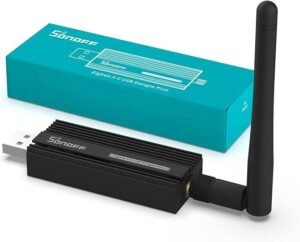
This is the undisputed king of value and the long-standing recommendation for most Home Assistant users. It’s affordable, incredibly reliable, and based on the powerful Texas Instruments CC2652P chipset that is universally supported. For a purely Zigbee setup that is guaranteed to work with almost any device, this is the smartest and simplest choice.
Best for: The user who wants the most reliable, “it just works” Zigbee experience for the lowest price.
2. Sonoff Zigbee 3.0 Dongle Plus (‘E’ Version)
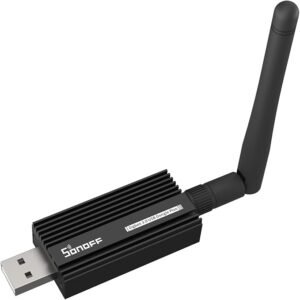
The ‘E’ version of Sonoff’s famous dongle is the future-proof upgrade. It swaps the older chip for a modern Silicon Labs EFR32MG21 processor. This not only makes it a powerful Zigbee 3.0 coordinator but also allows it to be flashed with firmware that supports the new Thread protocol, which is a key part of the Matter smart home standard. If you like to stay on the cutting edge, this is the dongle for you.
Pros: Modern, powerful chipset, supports both Zigbee and Thread for future-proofing, compact design.
Cons: Newer firmware can sometimes be less mature than the older ‘P’ version.
This for: The tinkerer who wants the latest technology and wants their setup to be ready for Matter and Thread.
3. SMLight SLZB-06 PoE Coordinator
For the power user who wants the absolute best performance, the SMLight SLZB-06 takes things to the next level. It’s a network-based coordinator that you connect via an Ethernet cable and can power with PoE (Power over Ethernet). This means you can place it in the most central location of your house for unparalleled range, completely eliminating signal issues caused by server racks or concrete walls. It’s the ultimate upgrade for a rock-solid, large-scale Zigbee network.
That : Place it anywhere for the best range, immune to USB interference, rock-solid stability via Ethernet.
Once for: Users with large homes or challenging layouts, and anyone who demands the most stable Zigbee network possible.
Conclusion: Our Final Recommendation
So, which is the best Zigbee coordinator for Home Assistant? The choice is simpler than it seems:
Choose the Sonoff Dongle (‘P’ Version) if: You want the most reliable, community-tested, and affordable option. It’s the gold standard for a reason.
Choose the Sonoff Dongle (‘E’ Version) if: You want a more modern and powerful chip that will support the future of the smart home with Thread and Matter.
With the SMLight SLZB-06 if: You have a large home or your server is located far from your devices, and you want the absolute best, most stable connection possible.
Do you need Zigbee, Z-Wave or both?
Zigbee and Z-Wave are different radio systems. A Zigbee coordinator will not control Z-Wave locks or sensors unless the hardware explicitly supports both. If your device list includes Z-Wave gear, plan that separately instead of assuming a cheap Zigbee USB stick will cover everything.
- Mostly Zigbee sensors, plugs and bulbs: choose one of the Zigbee coordinators above.
- Mostly Z-Wave locks, switches or sensors: look at a dedicated Z-Wave stick such as the Zooz 800 Series Z-Wave stick.
- Mixed Zigbee and Z-Wave: consider whether a combo adapter such as the Aeotec Z-Stick 10 Pro is worth the convenience, or run separate radios for easier troubleshooting.
Now that you’ve chosen your coordinator for your Home Assistant server, see our 10 Home Assistant dashboard ideas for layout inspiration.
Frequently Asked Questions
Which Zigbee stick is best for Home Assistant beginners?
The Sonoff Zigbee 3.0 USB Dongle Plus (P) is the most common pick: affordable, well supported, and easy to flash for ZHA or Zigbee2MQTT.
Do I need Zigbee2MQTT or ZHA?
Both work. ZHA is built into Home Assistant. Zigbee2MQTT supports more devices and exposes MQTT topics for advanced setups.
Can one Zigbee coordinator cover a whole house?
commonly yes in a typical home. Use a USB extension cable, pick a central location, and add mains-powered Zigbee routers (smart plugs) if devices drop off.
Does a Zigbee stick work with Z-Wave devices?
No. Z-Wave needs a separate stick. See the Z-Wave section above if your gear mix includes both.
How much does smart home gear cost over five years?
Sticker price is only part of the story. Hubs, repeaters, replacement batteries, cloud subscriptions and electrician call-outs can add up quickly on Australian 240 V installs. We compare total ownership cost in our reviews and link to primary references such as the Home Assistant documentation and the Matter specification when protocol compatibility matters. Budget for at least one spare sensor or switch when you standardise on a hub — mixed-vendor kits often need extra repeaters.
Cross-check compatibility, safety and local rules with official sources before you buy. Australian 240 V wiring, RCM labelling and hub protocols change with firmware updates, so confirm details against manufacturer docs and a licensed electrician when mains power is involved.
Which protocol should you standardise on?
Wi-Fi devices are easy to buy but noisy on your network. Zigbee and Thread/Matter devices usually need a compatible hub or border router, yet they tend to behave better when the internet drops. Before you bulk-buy sensors or switches, decide whether Modern Home Tech readers should prioritise local control, Apple Home, Google Home or Home Assistant — then pick products that match that path instead of mixing three ecosystems by accident. Thread border routers in Australia must still meet RCM requirements for radio equipment.
Which smart home news topics matter most for owners?
Protocol changes, security advisories and tariff updates affect real households more than launch-day hype. We prioritise Matter and Thread compatibility notes, recall notices, and energy price shifts that change whether automations still save money. Firmware regressions that break local control also rank above minor app redesigns — those are the updates worth reading before you buy more gear.
Cross-check compatibility, safety and local rules with official sources before you buy. Australian 240 V wiring, RCM labelling and hub protocols change with firmware updates, so confirm details against manufacturer docs and a licensed electrician when mains power is involved.